After years as Digital First AI, we are happy to announce our rebrand to DFIRST AI. This rebranding reflects our expanded focus on AI-driven creative tools and our commitment to new possibilities for creators everywhere. Try our new platform for free.
AI SEO Automation Guide for Agencies & Brands
This guide will help you make sense of AI SEO automation, encourage you to get started, and build the best automation setup you can confidently rely on.

Sonu kalwar
Share:

If the title of this post has caught your attention, I bet you’re already doing or thinking about doing LLM or GEO optimization for your organization or brand. At least, you must have heard about AI SEO and are curious to know how to make it work for your site.
Even if none of this applies to you, this guide will help you make sense of AI SEO automation, encourage you to get started, and build the best automation setup you can confidently rely on.
What’s inside is simple and practical by design.
Only spot-on and practical recommendations that you can implement immediately and see tangible gains expressed in traffic quality, and consistency of organic growth over time, with clear GEO and LLM-driven visibility improvements.
Automating AI SEO in the Age of GEO and LLM Search
What most people get wrong when hearing about automated SEO for AI is the primary target for automation. They think that they can automate how Google, Perplexity, ChatGPT, and others surface content.
But the truth is, you cannot automate how Google or LLMs (large language models) discover and retrieve content.
What you can realistically influence is the work that makes your content understandable, trustworthy, and retrievable by those systems.
The practical question to ask yourself is, which content and SEO processes can I automate to make my site easier for LLMs to understand and reuse?
GEO (Generative Engine Optimization) changes content discovery, moving it away from keyword saturation to actually being useful to real people with real queries. LLMs aim to understand the context and process content in a way that makes it easier to surface and cite.
For this reason, Google, ChatGPT, Perplexity, and Claude reward structured clarity over keyword density. They increasingly rely on the entity information (people, places, brands, contacts, etc.) to connect the missing dots between ambivalent concepts and provide clear and balanced answers people can trust.
Here is what AI SEO automation in the age of GEO implies:
The kind of automation you can do to your content and SEO to make it easier to discover and retrieve by LLMs.
Focus on making your content useful to real people, not search algorithms.
Providing entity information, since LLMs now use it as discovery and interpretation anchors.
⚠️ Important note: Not everything can and should be automated. Human judgment still outperforms AI in areas such as strategic thinking, understanding real user intent nuances, and interpreting results with subsequent decision-making and budget allocation.
How to Build an AI SEO Automation System That LLMs Can Understand
Automating your web presence is an ongoing process rather than just something you do once by updating your web content. The way to build a good automation system is to find tasks that directly impact how people see your company on search engines, build GEO-first workflows, and automate some of the content creation process with minimal human intervention.
Step 1. Identify SEO Tasks That Directly Influence LLM Visibility
The primary goal of SEO is building search engine visibility; however, not everything you do in SEO will affect visibility.
Your goal is to identify those tasks that play the biggest role in strengthening website (your brand, products, and services) visibility in the new LLM-driven search.
Typical high-impact automation targets include:
Entity extraction and enrichment.
SERP pattern analysis.
Topical gap detection.
Content structure normalization.
Link building, both external and internal (connecting related pages).
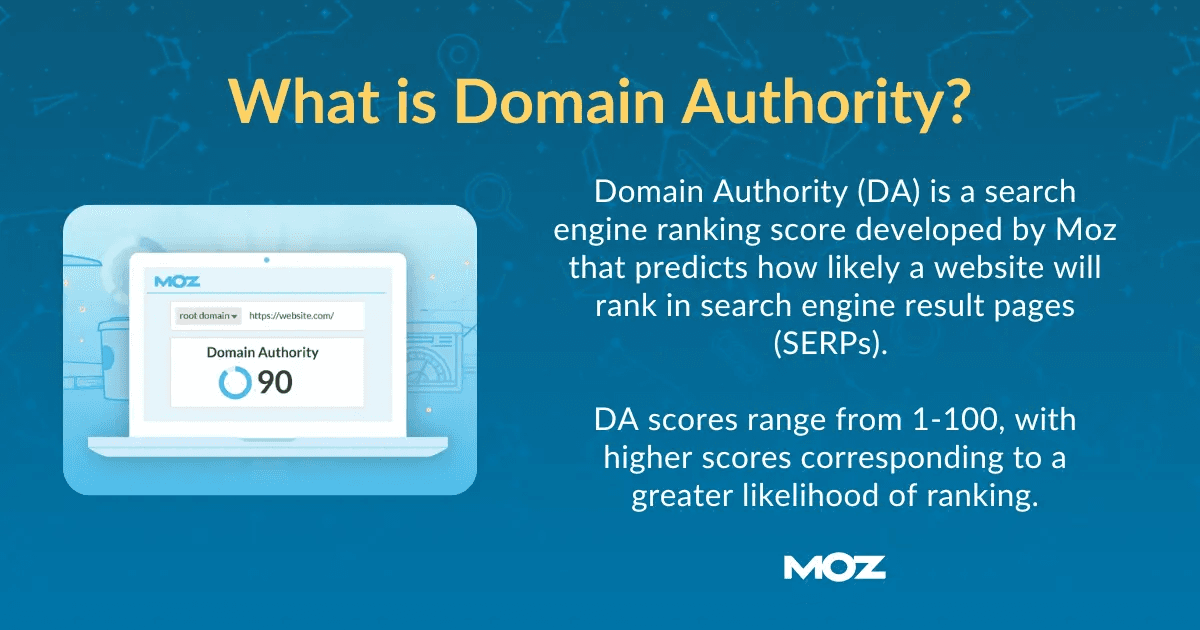
Links have a huge potential to improve visibility and simplify the discoverability of your content. However, for the sake of LLM discovery, not all links work equally, which is why checking domains for SEO is a critical visibility task.
Domains with the highest authority (DA) rating will send strong positive signals to generative search engines, increasing your chances of getting into the single answer window.
Source: Moz
Step 2. Use a GEO-First SEO Workflow
While traditional SEO workflows prioritize keywords and links, the LLM-driven workflows emphasize trust and relevance.
LLMs don’t crawl your website in a classic sense; they evaluate relevance, gauge the credibility of the source, and try to understand the content the way humans do. Then they extract the necessary answers in a structured form, matching those to the context of user queries.
That’s why a typical AI based SEO workflow that you should strive to build looks as follows:
Source credibility. It comes first because if the source is not worthy, nothing else matters. To improve credibility, you can:
Audit backlinks and remove low-trust domains.
Ensure consistent brand mention across authoritative websites.
Improve the quality of your content (expert-written, original, using data and insights, etc.).
Entity clarity. Remember, LLMs “feed” on entity information. The higher its quality, the better. So, add author, company, and contact information to your pages.
Structured answers. Structural information lowers the cognitive load for humans, and machines follow the same cognitive pattern. Here is what you can do to improve the structural clarity of your content and to ensure LLMs can always find the answers they need:
Add clear definitions (1-2 sentences per definition is enough).
Use step-by-step explanations where applicable.
Insert lists and frameworks that help AI read and understand your content.
Use predictable sectioning across pages and subpages.
Contextual linking. More links are no longer a winning tactic in the age of AI for SEO. Your links should be contextually relevant and help readers understand content, not divert their attention. LLMs find supporting context in those links and, by doing so, enrich their answers. Given that, here is what you could do:
Use natural, descriptive anchor text in related pages.
Build topic clusters around main themes.
Use internal linking to enhance readability.
Use authoritative external sources.
One practical GEO strategy is to outsource your ads for momentum and secure UK backlinks to validate authority. This will increase your website traffic and send a strong positive signal to LLMs that your pages can be trusted and the information they have is worth including in their answers.
Step 3. Generate LLM-Ready Content Briefs Automatically
Put simply, content briefs help LLMs understand your pages better. I’ve seen plenty of examples where content briefs, empowered by relevant tools, when applied strategically and systematically, have done wonders for website LLM discoverability.
In a GEO-driven search, content briefs serve two functions:
Help humans make content easier and understand it better.
Help machines understand your content (serve as a translation layer between search intent and machine understanding).
📌 Implementation note: The goal of automation here is to use structured briefs to explain a topic better (more efficiently and in-depth).
Here is what your ideal GEO-ready brief must contain:
The primary question to answer a specific query.
Supporting sub-questions.
A list of required entities and definitions.
Preferred content format (steps, list, table, graph, or framework).
Internal references to strengthen topical authority.
What are your automation best practices?
You can use automation to extract frequently asked questions from search engine results pages (SERPs), compare competitor content (including entity data), and organize headings and body copy (the order of the sections).
Scaling SEO Automation Without Losing Control
Automation tends to get messy with time and volume. Even if your current operations remain stable and nothing portends automation problems associated with growth, trust me, eventually you’ll face that challenge.
The things that can prevent losing control over automation and stop the chaos from spreading are rather simple: setting transparent governance rules, avoiding common mistakes, and increasing order in the decision-making process.
Set AI SEO Governance Rules for Teams
It’s a common misconception that increasing governance and making rules in business always lead to bureaucracy and stall growth.
In fact, any open system, such as marketing or SEO, when growing, tends to increase order and complexity, provided it follows clear governance rules.
I assure you, this is a universal law.
In physics and nature, for example, the same rule applies to closed and open systems, governed by the same laws, such as thermodynamics or Newtonian mechanics. This is called entropy (disorder), and it's been well-studied for ages.
By defining clear automation rules and implementing governance frameworks, you help your SEO team members work as one towards common goals. And without this gentle governance nudge, their small deviations (which are inevitable) quickly grow into visible problems.
This is what you can do:
Define what AI can and cannot do in your automated SEO operations.
Standardize prompt libraries so that nobody invents a bicycle and uses AI to its full potential.
Control tone, brand voice, and compliance in internal and external (outreach) communications.
Prevent content duplication risks by setting clear goals and allocating responsibilities evenly.
The last point can be fairly easily realized by adopting a common toolkit for checking content uniqueness and editorial clarity.
For example, tools like Duplichecker or Copyleaks are free to use but are commonly recognized as among the best in their class.
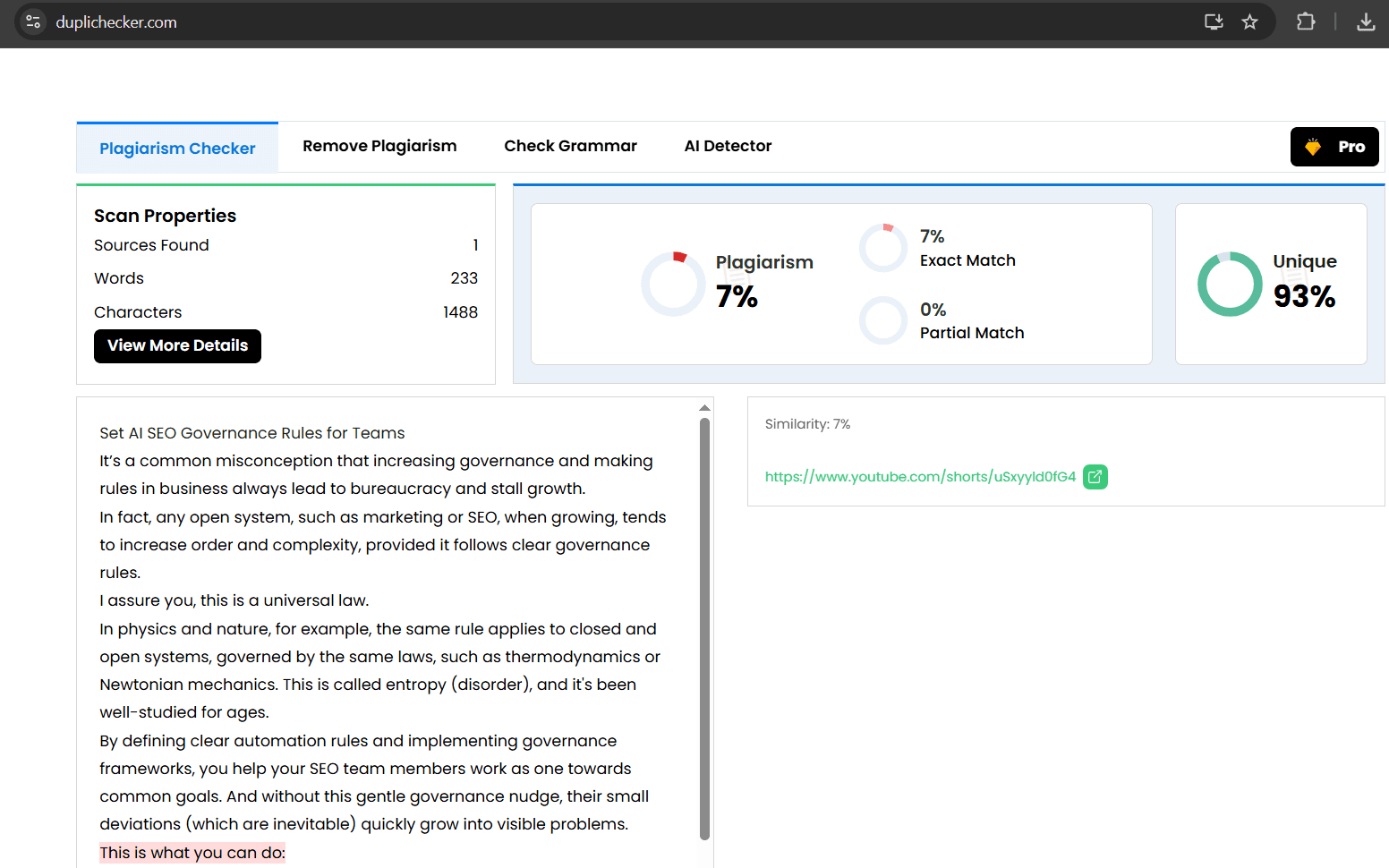
Source: Duplichecker
Automate SEO Reporting and Decision-Making
Reporting in general and in SEO in particular can take a lot of time. In an expanding organization, where the SEO team is constantly growing, reporting tends to become overly complex.
Taken alone, this may not be a problem, but in an environment where success depends on timely decision-making (if we talk about conscious or informed decision-making), this quickly becomes the bottleneck of progress.
Automating reporting typically comes down to these few things:
Generating weekly and monthly AI-powered SEO summaries.
Automating anomaly detection (traffic drops, ranking losses, or engagement spikes).
Translating data from SEO metrics and KPIs into plain-English insights.
📌 Implementation note: One important goal of automation in reporting is to save your analyst hours without losing accuracy. More freed-up resources mean people can do other important things, like taking part in key projects to implement the decisions made.
Avoid Common AI SEO Automation Mistakes
To scale GEO automation without losing control, avoid these five common pitfalls:
Automating strategy instead of execution. AI can effectively streamline reporting and content production, but delegating it to make strategic decisions is risky, at least at the current state of AI development. Strategy should be owned by human experts.
Scaling automation before governance is defined. If you don’t define rules and set boundaries before scaling automation, it can quickly get messy and slow down your development, costing you extra money.
Prompt fragmentation. This mistake is about team alignment in general, where prompt fragmentation is one pivotal manifestation. Avoiding is simple: I always recommend clients implement only high-performing prompts and assign responsibilities to monitor execution.
Overproducing content without a topical focus. When you allow AI to produce content at scale, but don’t keep a human eye on what it's doing, you may quickly lose topical focus. This will mean lower SEO rankings and poor chances of getting into the LLM answers.
Overly relying on AI in content production. As of 2026, AI’s capabilities still require human oversight and guidance. Removing humans from the content production loop is far too risky.
📌 Remember: Every automation system delivers what it was programmed to do. Nothing more or less. For your AI SEO automation to reach its full potential and to consistently deliver you great results, it must be thoroughly planned, supported by common governance, and designed to monitor and promptly react to automation side effects.
The Bottom Line
AI SEO automation is not just another fancy term in the notorious AI bubble; it’s a practical tool and a pressing need for businesses, organizations, and individuals. The old-fashioned SEO practices, where keyword density and link volume used to define discovery, are losing viability with the same blasting speed that the LLM- or GEO-driven search comes to our lives.
If you want to thrive in this new online discovery reality, you need to implement LLM-friendly content optimization practices and automate them from day one. This stipulates two key things:
Automate what makes your content clear and reusable for LLMs, not the outcome itself.
Scale automation only where rules, ownership, and human judgment remain explicit.
Out of all material we’ve covered so far, I think these are the two major beacons that will help you stay on the right automation track and avoid most pitfalls.
Only once you get comfortable scaling your operations while maintaining automation discipline can you build a sustainable AI SEO optimization system that actually delivers long-term visibility.